NOTE: This article was originally published in the inaugural issue of CAELi Journal in November 2023. Although artificial intelligence was already undergoing significant development at that time, its rapid advancement has taken on increasing importance in light of the major astrological alignments of July 2026 and the current stationing direct of Pluto in Aquarius, out of bounds in southern declination. I am resharing this article now because its exploration of Polaris, our North Star, moving into increasingly close alignment with the north celestial pole over the coming century—and its symbolism of true north—feels more relevant than ever. Support the library and educational resources of the CAELi institute!
Pole Star Epochs: From the Dragon to the Bear
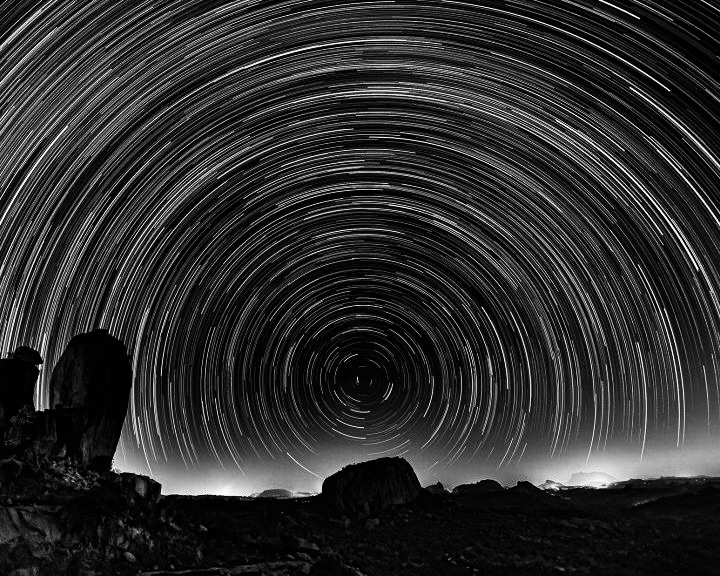
North Star and lodestar, Polaris is a guiding light placed at the pivot around which the stars of the northern hemisphere rotate. Ever present at the north celestial pole as we endlessly whirl around Earth’s rotational axis, Polaris is as constant as Ananke and her spindle around which the starry spheres spin. Never rising nor setting, Polaris traces a tight circle in the sky due to its proximity to the pole. From Earth, it seems rooted in its central spot like a World Tree or Axis Mundi. On the tail of the Little Bear, Polaris—and the stars of the Great Bear who ceaselessly rotate around the pole star’s central position—, has served as a navigational guide for sailors journeying to distant lands by sea and slaves escaping to freedom in the North. We have become so accustomed to seeing Polaris at the dead center of the night sky that we imagine that it has always been there. But this has not always been the case.
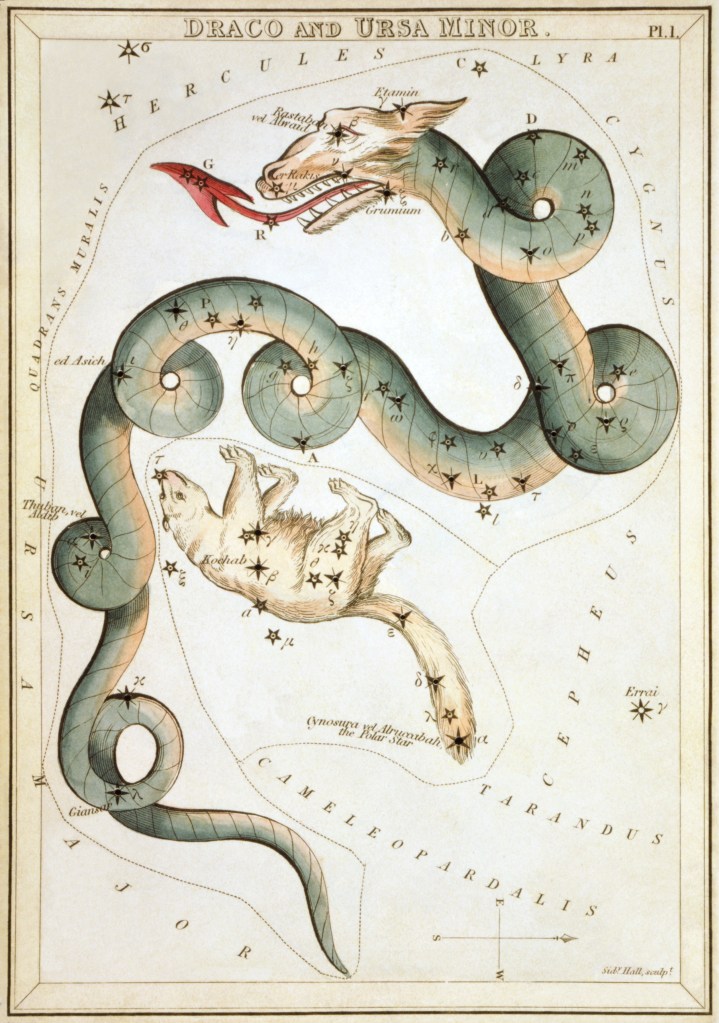
In fact, in the roughly 26,000 years it takes the Earth to complete its axial wobble, the north celestial pole slowly circumambulates around the sky. In some eras, there is no visible star at its central northern position. Roughly 14,000 years ago, Vega in the Lyra constellation served as the pole star. More recently—5,000 years ago—, Thuban in Draco the Dragon served its tenure. Thuban was the pole star when the Great Pyramids of Egypt were built, claiming its status from approximately 3942 to 1793 BC. Thuban’s position as a pole star was especially notable because of its exact presence on the northern celestial pole in approximately 2787 BC. There is only one other visible star that comes close to the exactness of Thuban within the 26,000 year cycle: Polaris. By the end of this century—around 2100 AD—, we will experience Polaris at its closest proximity to the pole. It is the only star besides Thuban to be so exactly placed there. We are at an incredibly unique time in the Earth’s axial precession, one that will only intensify during the century ahead.
Due to rapid advancements in AI technology, and other factors, there is a growing collective sense that we are living during a transitional time of immense change and uncertainty that has resonance with an epochal turning. In the 20th century, C. G. Jung brought attention to the idea that epochs of time are defined by the constellational stars that align with the Aries equinox when he explored the rise of Christianity and its associated fish symbolism against the backdrop of the shift from the Age of Aries into the Age of Pisces. Before the atomic bombs of the 1940s, Jung predicted the decade would be important due to the astronomer Rebekka Aleida Biegel’s claim that the equinoctial point would reach a midpoint between the last star of the Pisces constellation and the first star of the Aquarius constellation in 1940. Biegel calculated that two different stars within Aquarius would align with the equinoctial point in 2129 and 2245. In a footnote in Aion, Jung gave a broad range of 1997 to 2154 for the shift into the Age of Aquarius, stating that the exact calculation would depend upon methodology, as well as which stars associated with Aquarius were seriously considered. The important point here though is Jung’s emphasis on precessional alignments with fixed stars, and the living symbolism of their constellational imagery. More recently, Robert Hand has drawn from the same idea to demarcate epochs based upon precessional alignments with the Capricorn Solstice. He notes the importance of our shift away from stars in Sagittarius into our present alignment with stars in Ophiuchus, the Serpent Bearer.
In Babylonian Star Lore, Gavin White theorized that Babylonian astrologers probably connected the changing position of the pole star with the turning of great epochs, similar to our contemporary ideas about the vernal equinox shifting from Pisces to Aquarius. White wrote that Babylonian astrologers called the circumpolar star region the “Exalted Temple,” revealing the importance they gave to the area of the sky that held the axis of the heavens. Although Babylonian astrologers knew that Thuban marked the Exalted Temple in their own time, they were aware that Polaris would eventually claim the title: they called it the “Inheritor of the Exalted Temple.” Due to the Draco constellation’s prominence at the center of the exalted circumpolar region for so long, it is fascinating to consider the central importance of Tiamat, the great chaotic serpent goddess, in Babylonian mythology.
In China, Thuban reached the exact north celestial point around 2787 BC, which aligned with the reign of the Yellow Dragon: the legendary Emperor Hungdi who was said to have begun his rule around 2697–8 BC. Hungdi presided over a Golden Age, and was said to have introduced gifts of civilization such as writing, lunar calendars, wooden homes, and new transportation methods like carts and boats to his people. He was seen as the “Yellow Deity with Four Faces,” each face representing the central unity of all four directions, similar to the symbolism of a pole star. After his death, the Yellow Emperor was said to have become an immortal dragon who ascended to the heavens above.
It is interesting that so many cultures around the world, like those of Yoruba people and certain aboriginal tribes in Australia, portray serpents as creator deities or give great prominence to serpentine deities such as the Naga in India. After Thuban began fading away from its central proximity as a pole star in 1793 BC, another dragon star (Kappa Draconis) became an approximate pole star until roughly 1100 BC when another transition began. At this time Kochab in Ursa Minor began vying for pole star status, although it never came nearly as close to the northern celestial pole as Thuban did. The transition out of what appears to be an Age of Dragons began around this time, although some cultures viewed Ursa Minor as the wings of the Dragon and so might have continued connecting it with serpentine imagery. The MUL.APIN, which was compiled during this transitional time (around 1000 BC), depicted Ursa Minor as being one of the two Wagons of Heaven (Ursa Major being the other), with the ropes of the wagons bridging heaven and earth.
Thales of Miletus, who lived from approximately 626 to 545 BC, has been credited with naming Ursa Minor and recommending its use as a navigational constellation for due north. Although there was no exact pole star during this era, Ursa Minor would have been clearly moving into a central position as Draco was fading away. By the time Aratus wrote his legendary text Phaenomena in roughly 276 BC, Ursa Minor was not only described as possessing the greatest value as a celestial cynosure for the straightest course in navigation, it was also called “Cynosura” drawing on its connection with one of the nymphs who nursed Zeus on Mount Ida. Aratus named Ursa Major after Helike, the other nymph who raised Zeus. The birth of Zeus announced a new era of Olympian gods who would overcome the old gods ruled by Cronus. Importantly, one version of the story directly linked the constellations of Draco, Ursa Minor, and Ursa Major with this epochal shift. It was said that when Cronus was searching for the infant Zeus on Crete to destroy him, Zeus hid himself by transforming into a serpent (drakōn) while also transforming his two nurses into bears. Thus the circumpolar stars took on the identity of the progenitors of the new Olympian Age.
But what exactly does a slow shift from an Age of Dragons to an Age of Bears signify? In Bear Doctors: Tracing the History of Bears as Healers and how they became Christian Saints, Roslyn Frank documented an archaic belief amongst people from Basque country in the Pyrenean region, that humans descended from bears. There are other cultures around the world who have believed in an ancestral link between humans and bears, too. The link seems justified by bears’ ability to walk upright on two feet, their similar anatomy, intelligence and dexterity, and our shared omnivorous diets and “sweet tooths.” Some believe humans could have learned some traditional medicine from observing bears self-medicate with plants. Potent healing abilities as well as resurrective capacities were ascribed to bears due to their cyclical hibernation. Could there be a connection here between the increasing importance of Polaris and Ursa Minor approaching the north celestial pole?
The pole shift from dragons and snakes to the bear/human is clear within the development of Abrahamic religions through stories like that of Adam, Eve, and the serpent. Many deities, like the Greek Zeus and the Mesopotamian Marduk, took on an anthropomorphized appearance. Human domination over serpents features greatly in both of their stories: Zeus slaying the serpentine Typhon and Marduk splitting the great serpent Tiamat in half, creating the heavens and the earth out of her body. The Islamic tradition has taught that Allah created the jinn before he created Adam. Jinn were thought to be able to take—and had a preference for—serpent form. Indeed, it’s common today to hear our world described as an anthropocene, an epoch of time dominated by the impact of humans.
By the time that Pico della Mirandola wrote his Oration on the Dignity of Man in 1486, a text that has been linked with the wider collective movement to center humans above all other beings, Polaris had moved much closer to the northern celestial pole and had become the pole star. Mirandola wrote that the ‘nature of all other beings is limited and constrained within the bounds of laws prescribed,’ while humans in contrast can set the limits of their own nature through the desires of their free will (cited in Cosmos and Psyche, 4). In the 20th century, humans developed atomic power and unleashed the atomic bomb as Polaris came even closer to the pole than it had been. Today, as Polaris is coming even closer to the exact pole position, humanity is rapidly developing artificial intelligence at such speed that questions of a looming AI singularity have grasped the collective imagination.
Rather than continue on a path of further separation from nature, perhaps our ancestral roots in the animal world could point toward a rebalancing taking place in a more animistic direction. The central premise behind Robert Hand’s exploration of the Capricorn solstice aligning with the stars in Ophiuchus’ serpent-holding-hand is that the centralization of these stars indicates the critical necessity of humanity coming to terms with their consumption and control of the natural world, or risk destroying themselves through ecological disasters and crises. Similarly, Jung associated the transition from the Age of Pisces to Aquarius as being extremely perilous with vast potential for humanity to self-destruct. As the Aries equinox continues to move toward eventual alignment with Aquarius, the most human of all the zodiac signs, perhaps there is a convergence of focus on the human in the century ahead that will demand responsibility and usher in a rebalanced relationship between us and the world around us. One thing is clear: Polaris will be getting even closer to the north celestial pole in the century ahead.
References:
Eratosthenes and Hyginus Constellation Myths with Aratus’s Phaenomena. A new translation by Robin Hand. (2015). Oxford University Press.
Frank, Roslyn. (2022). Bear Doctors: Tracing the History of Bears as Healers and How they became Christian Saints.
Greene, Liz. (2018). Jung’s Studies in Astrology: Prophecy, Magic, and the Qualities of Time. Routledge.
Hand, Robert. (2014). The Precession of the Capricorn Solstice and the Importance of 2017 to Humanity. The Mountain Astrologer. October/November 2014 issue.
Jung, C.G. (1981). Aion: Researches into the Phenomenology of the Self. Routledge. Fifth edition.
McLure, Bruce. “Thuban was pole star for the Ancient Egyptians.” Earthsky, 9 August 2023, https://earthsky.org/brightest-stars/thuban-past-north-star/
Ogden, Daniel (2013). Drakon: Dragon Myth and Serpent Cult in the Greek and Roman Worlds.Oxford University Press. p. 164
Tarnas, Richard. (2007). Cosmos and Psyche. Plume.
“Thales of Miletus.” Wikimedia Foundation, last modified 29 September 2023, https://en.wikipedia.org/wiki/Thales_of_Miletus
White, Gavin. (2007). Babylonian Star-Lore: An Illustrated Guide to the Star-lore and Constellations of Ancient Babylonia. Solaria Publications.
“Yellow Dragon,” Wikimedia Foundation, last modified 13 August 2022, https://en.wikipedia.org/wiki/Yellow_Dragon
“Yellow Emperor,” Wikimedia Foundation, last modified 29 July 2023, https://en.wikipedia.org/wiki/Yellow_Emperor

